the haunted manor
Stanislaw Moniuszko
Staatstheater Wiesbaden
Teatr Wielki Poznan
“Impressive political musical theater at the May Festival. Politics on the opera stage, often sought, sometimes forced, rarely spot on, but here: effortless and moving. The punchline: wicked and elegant.”
Frankfurter Rundschau
“The Poznan new production directed by Ilaria Lanzino, created a year ago, revealed much about the current sentiments and challenges in the neighboring country. The Italian director, who also works in Germany and other European countries, delicately referenced recent ‘political events’ in Poland. (…) The ghosts supposedly haunting the titular ‘Haunted Manor’ are not of the past but of the present, as foreshadowed by video projections. Soon, the gentlemen in their antiquated breastplates must navigate a diverse society among colorful stairs, same-sex couples, party-goers, and women in headscarves.”
Frankfurter Allgemeine Zeitung
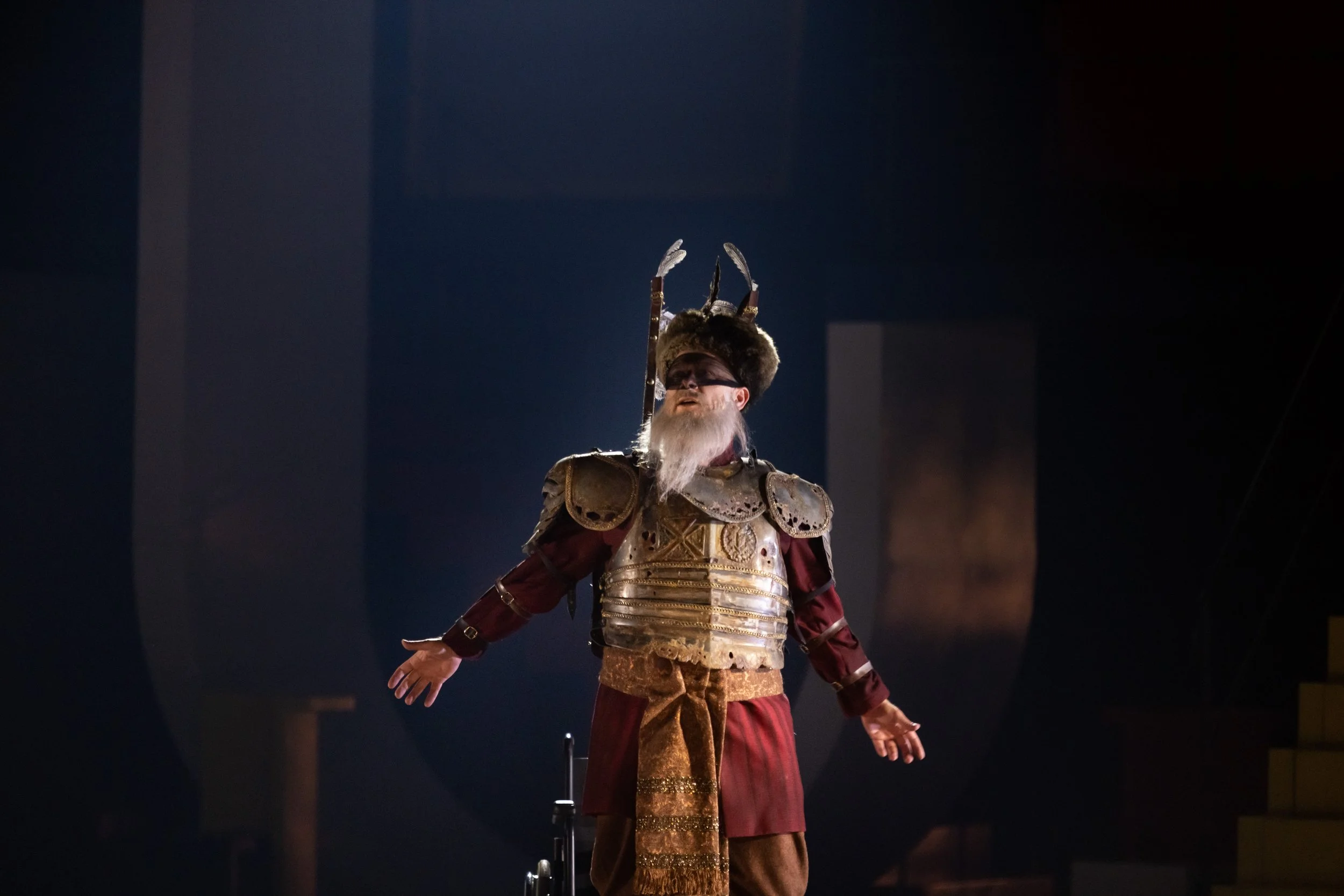
“The Italian director asks who—or what—is doing the haunting. (…) She highlights the story’s generational and gender conflicts, showing how the men—traumatized by war—are living in a nostalgic past but finally have their eyes opened. It’s a feminist view yet one showing some empathy with the men and their old values, especially the sword-bearer Miecznik, father of the spirited sisters Hanna and Jadwiga. Solidly sung by the baritone Stanislav Kuflyuk, he is presented as blind and wheelchair-bound—and liberated at the happy end. Similarly, the portrayal of the foppish outsider Damazy (the tenor Szymon Rona) shows him as a transvestite being beaten, but Lanzino’s version ends with a triple rather than double wedding—gay marriage for Damazy being a well-aimed, topical shot across the bows of Poland’s socially conservative government (…) a new interesting staging.”
International Opera Magazine
“Revelation! I don’t hesitate to use that word. The young Italian director has studied Moniuszko’s music and Chęciński’s text in depth. She showed ‘The Haunted Manor’ for our times. (…) In my opinion, this is where the power of the so-called ‘modernization’ lies, and in fact the new reading of the old masterpieces. Finding the idea in the matter of the work and not outside it under any pretext. Which, unfortunately, is often the case with inept and arrogant directors. Ilaria Lanzino is their opposite. Not only is she talented, but she also has the wisdom to be (not only) humble about the work she has taken on. The virtuosity of this performance is captivating. (…) There is another theme: the victory of women and the female point of view. They are the ones who bring us into the 21st century. Now someone will tell me that this is a political spectacle, because women’s protests, defending the Constitution, is a political manifesto. Yes, it is a political manifesto (…) This is the truth. And a young Italian woman, remember her name, because it’s worth it: Ilaria Lanzino, knows it perfectly well, or with her unfailing artistic intuition she has read it. (…) May it continue in the opera theater and also in the theater of our life.”
Piotr Nędzyński, Maestro.net.pl
“Moniuszko falls over in his grave. He rolls over, rejoices, and can’t believe that his ‘Haunted Manor’ continues to scare, make you think, and inspire. And how it does! And that at the same time some of his compatriots are pissed off, screaming and shouting about feminism, LGBT, and ‘gender ideology’—all the better. Let it scream in its last gasps, because nothing can stop this energy and change of thinking about statehood, Polishness, humanity, and patriotism. (…) Director Ilaria Lanzino’s interpretation is full of understanding for all the characters in the opera. The scene that drives the whole plot, in which Zbigniew and Stefan swear never to marry and utter the words of greater importance—‘There are no women in our cottage’—is perceived by the director as a moment of radicalization after the trauma. Men who have lost everything become distrustful, closed off to the world and locked into history. The reflection, the bottle of alcohol, the anger, the fear and the helplessness—this is the portrait that an eye that is harsh on men, but also full of understanding, has eviscerated. (…) At first, ‘The Haunted Mansion’ directed by Lanzino seemed to me a story about conflicts—ideological, gender, generational. It is an interesting, but still quite obvious story about the fact that liberalism and openness scare in ‘The Haunted Manor’—and this is what the men and the older generations of heroes are afraid of. And yet there is more gray in the director’s intention, more searching for common points, perhaps brief but important moments in which the division between us and them ceases to be valid. We can see it in the armor being thrown off, in the changes of relations between the main characters and those in the background. Thus, the message of the opera is about getting to know the other—without expectations or prejudices. About being with each other in everyday life and without labels. Then a feminist, an LGBT+ person, a patriot, a veteran, a soldier will simply become a human being with whom, horror of horrors, you can even fall in love. (…) This new interpretation of ‘The Haunted Mansion’ says a lot about us. The director’s fresh eye, the lack of automatism in her perception of history, the introduction of universalism in place of messianism, make this one of the most daring and interesting opera productions that have been staged in Poznań in recent years.”
Kultura.poznan.pl
“Ilaria Lanzino boldly but also sensitively refers to iconic Polish characters. As she said, before starting her work, she immersed herself in our history, she also learned enough Polish to be able to work with the original text of the libretto, not with translations. And although she staged a feminist play, she remained faithful to Moniuszko, because in his opera women led the plot and men submitted to their will. And thanks to this staging, ‘The Haunted Manor’ has become a universal work, understandable not only to Poles. (…) Some threads introduced by Ilaria Lanzino remind us of what we are currently experiencing. Damazy is a gay man persecuted by men, the sleigh crowd of guests has become an armed country mass, which under the leadership of Cześnikowa, holding a cross in her hand, wants to defend the tradition. So the young Italian made us realize that the national sanctity of over 150 years ago can take on contemporary meanings. So, instead of protecting national treasures from interference by the world, we should learn from those who are not afraid to entrust their most valuable works to foreigners.”
Onet Muzyka
“It is a must-see. The Grand Theatre in Poznan consistently promotes its patron in an innovative way. We saw a never-before-seen version of ‘The Haunted Manor’. The story of the beautiful maidens from Kalinowo in the era of Instagram can be liked. Although to some it may seem extravagant. Certainly purists of the history of Polish music will be surprised. However, no one in this production takes away Moniuszko’s greatness. It is still an opera about the conflict of genders and generations. And the reinterpretation of this monumental work can update its issues in a way understandable for those who visit the opera rarely, and those interested in such a realization will buy tickets for themselves and their friends. This production of ‘The Haunted Manor’ has ceased to be a collection of patriotic melodies close to the heart, and has become a topic for discussion of traditional values.”
e-teatr.pl
“Lanzino (…) allows the universal, comedic ambiguity of language to be consistently highlighted. On the level of a joke, fortune-telling wax turns into depilatory wax—the word remains, the content changes. On a more serious level, the director brings out the dimension of an aggressive threat hidden in the world of Old Polish customs, as seen in ‘Od terema do terema’ (‘Hey Miecznik! zima tęga, / Od celnicy dawaj klucz!’). The play with language culminates in the scene of Damazy’s proposal. In Lanzino’s work, the lyrical tenor kneels before a man. The situation is in obvious contradiction with the didascalia, but the spoken text does not invalidate the image on stage. When announcing his intention to get married, Damazy does not say Hanna’s or Jadwiga’s names. In Chęciński’s play, he is interrupted by jealous rivals. In Lanzino, a play on cognitive filtering emerges: the interventions of Stefan and Zbigniew prove the primacy of mental categories over sensual experience. Heterosexual Sarmatians see a man kneeling before another man, but they do not really see him. They hear a male-male proposal, but they don’t really hear it. The comedic night, known for example from the finale of ‘Le nozze di Figaro’, shrouds not the eyes but the ability to evaluate facts. (…) In the aria with a chime, Hanna does not watch Stefan from a distance, but interacts with him from the very beginning. By making the hero’s mother’s singing present, she creates an event whose scale exceeds her expectations: Stefan leaves the ‘modern’ space of the Swordsman’s manor, only to wander a moment later among the ruins of his family home. Hanna follows him. This walk, like the adventure of Eurydice and Orpheus, turns out to be a journey into the hell of trauma. Hanna silently contemplates the fragments of the shattered wall. When Stefan’s emotions reach an unbearable pitch, she comes to the rescue. She pulls him unconscious into a safe space. What is interesting here is not so much the reading of the situation, realistic in its starting point, as its effect. With Ilaria Lanzino, Stefan does not sink into narcissistic contemplation, but talks about his own emotions. He communicates them—for the first time—in a language readable to a modern woman. In turn, what was at first just an experiment or a game for Hanna evolves into a profound experience based on empathy. Instead of male exuberance, we see an adult conversation about pain, loneliness, leaving one’s comfort zone, compassion, friendship, and the possibility of support. This lends new credibility to the birth of love shown in the opera. Their unexpected motto could become the words from Verdi’s Otello: ‘E tu m’amavi per le mie sventure / ed io t’amavo per la tua pietà’ (And then you loved me for my misfortunes, and I loved you for your compassion).”
Ruch Muzyczny
“Italian Ilaria Lanzino read out a piece from our national canon without patriotic burdens and succeeded. There are various references to contemporary issues. For the young Italian woman makes us realise that the national sanctity of over 150 years ago can take on contemporary meanings. And the feminist pronouncement does not misappropriate Moniuszko. After all, in his ‘Haunted Manor’ it was the women who carried out the intrigue and the men who submitted to their will.”
Rzeczpospolita
“Flying the rainbow flag on stage in a country that has established ‘LGBT-free zones,’ during the performance of an opera considered a national opera in Poland, was an act of courage and defiance by the Italian director, which the younger, more open-minded audience understood and appreciated.”
Opera
Stage direction: Ilaria Lanzino
Stage and costume design: Leif Erik Heine
Light design: Wiktor Kuzma
Video design: Leszek Stryla
Fotos: Bartek Barczyk