bluebeard‘s castle
pimpinone
B. Bartók & G.P.Telemann
Staatstheater Nürnberg
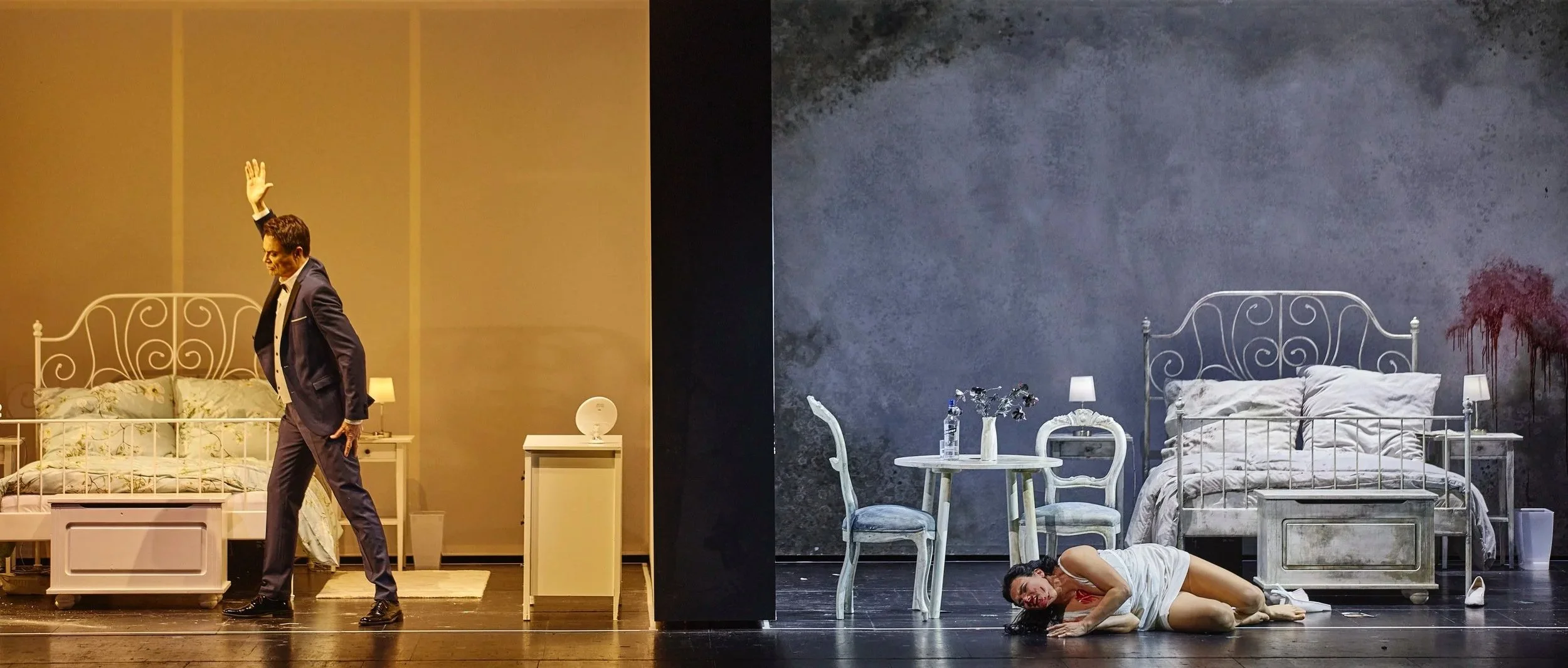
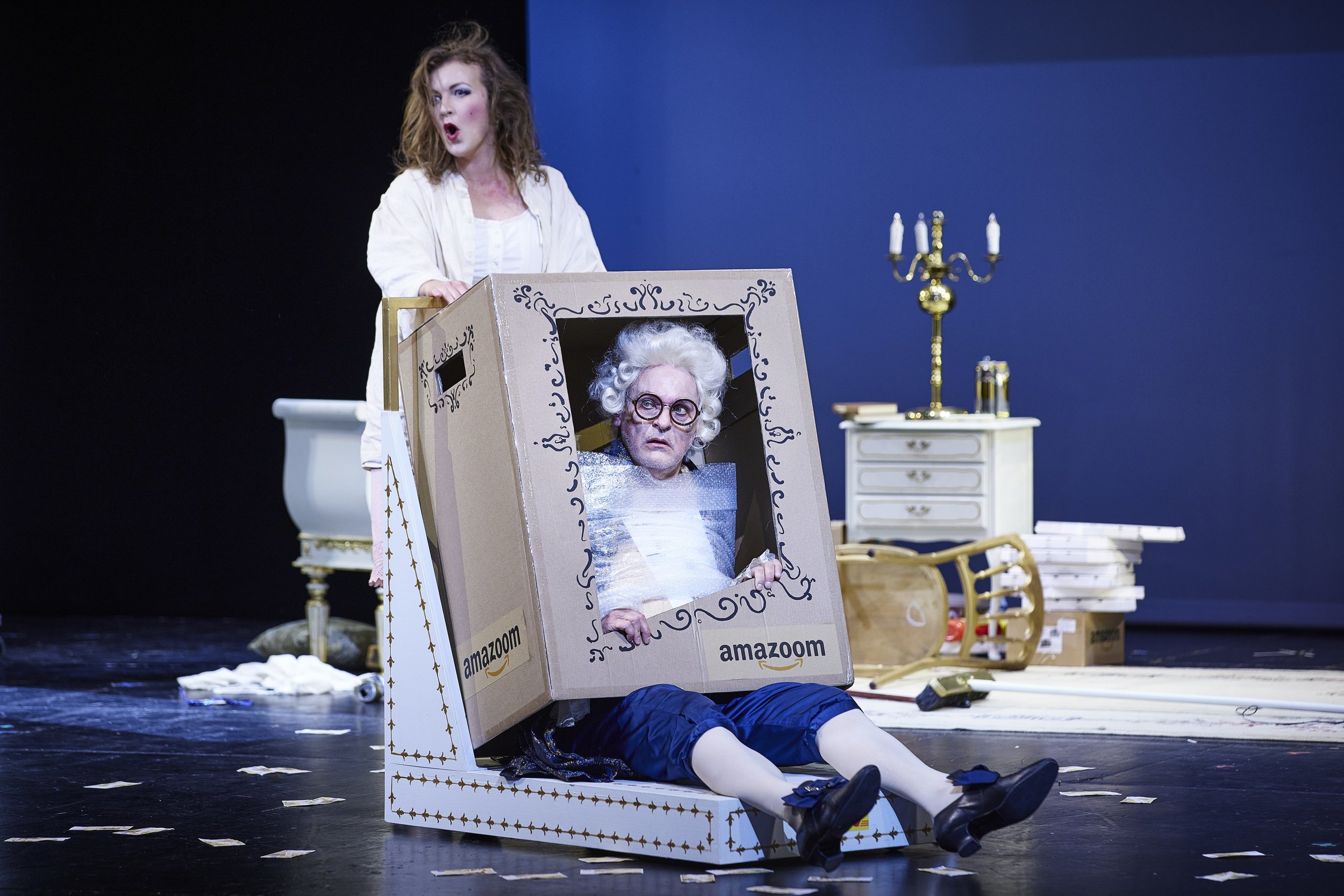
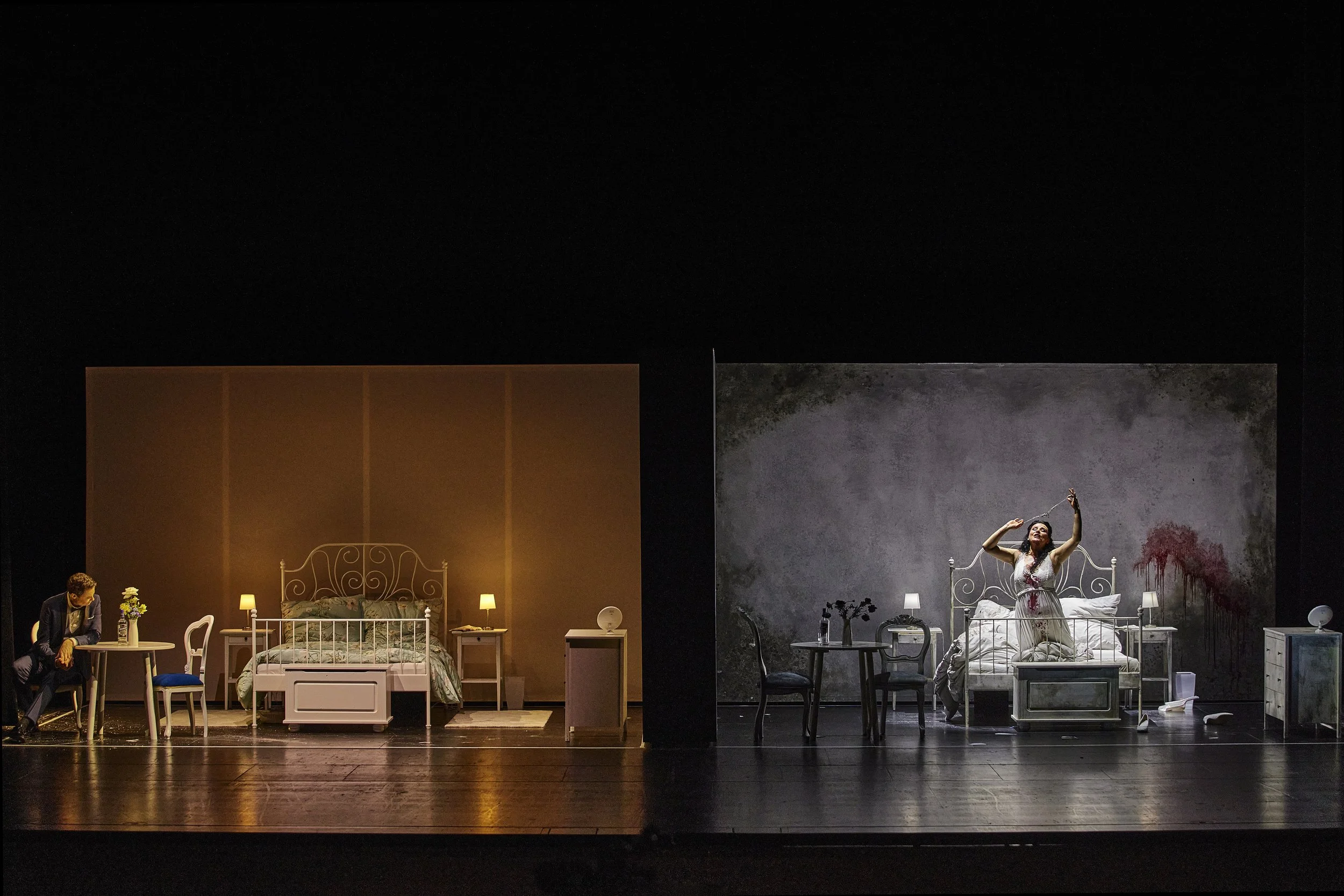
“The 250 spectators applaud as if they were ten times as many, and they simply do not stop. This joy is fully justified. As different as the two works are—the first a light-hearted Baroque intermezzo, the second an expressive gender struggle from 1911—they are united by a common theme. In short, the failure of a marriage, told by Ilaria Lanzino as two variations of the awakening of female self-determination. (…) And initially, this is done with great wit. The wealthy Pimpinone is looking for a companion who will primarily run his household. Lanzino takes this very literally, letting Hans Gröning enthusiastically search the internet for the perfect household robot. During this search, brief news items about the warlord Tamerlano appear—Telemann once inserted his humorous intermezzo between the acts of Handel’s opera of the same name at its premiere. A charming messenger then delivers Vespetta into Pimpinone’s prettily Baroque-suggested home; she behaves like a Baroque ironing automaton, so delightful that her owner decides to marry her. Then Vespetta comes to life, and the radiant Maria Ladurner confidently shatters all household-helper fantasies. (…) On its own, Pimpinone is no more than a delightfully melodic Baroque joke. But it is followed by the dark side of marital warfare. For this, the conductor (now Johannes Rumstadt), the musicians, and the stage design are changed, and Lanzino’s directorial style shifts from the concrete to the more psychotic. This is briefly disorienting, as Bluebeard and Judith never make contact and inhabit two separate bedrooms, but it soon becomes fascinating through the precision of action and reaction, even across great distance. Almerija Delic captivates with expressive intensity, Jochen Kupfer with a confident study of a man closed in on himself; both are very contemporary and psychologically truthful. In the end, Judith triumphs, leaves this bundle of male neuroses, and stands self-determined in the light. Then the jubilation erupts.”
Süddeutsche Zeitung
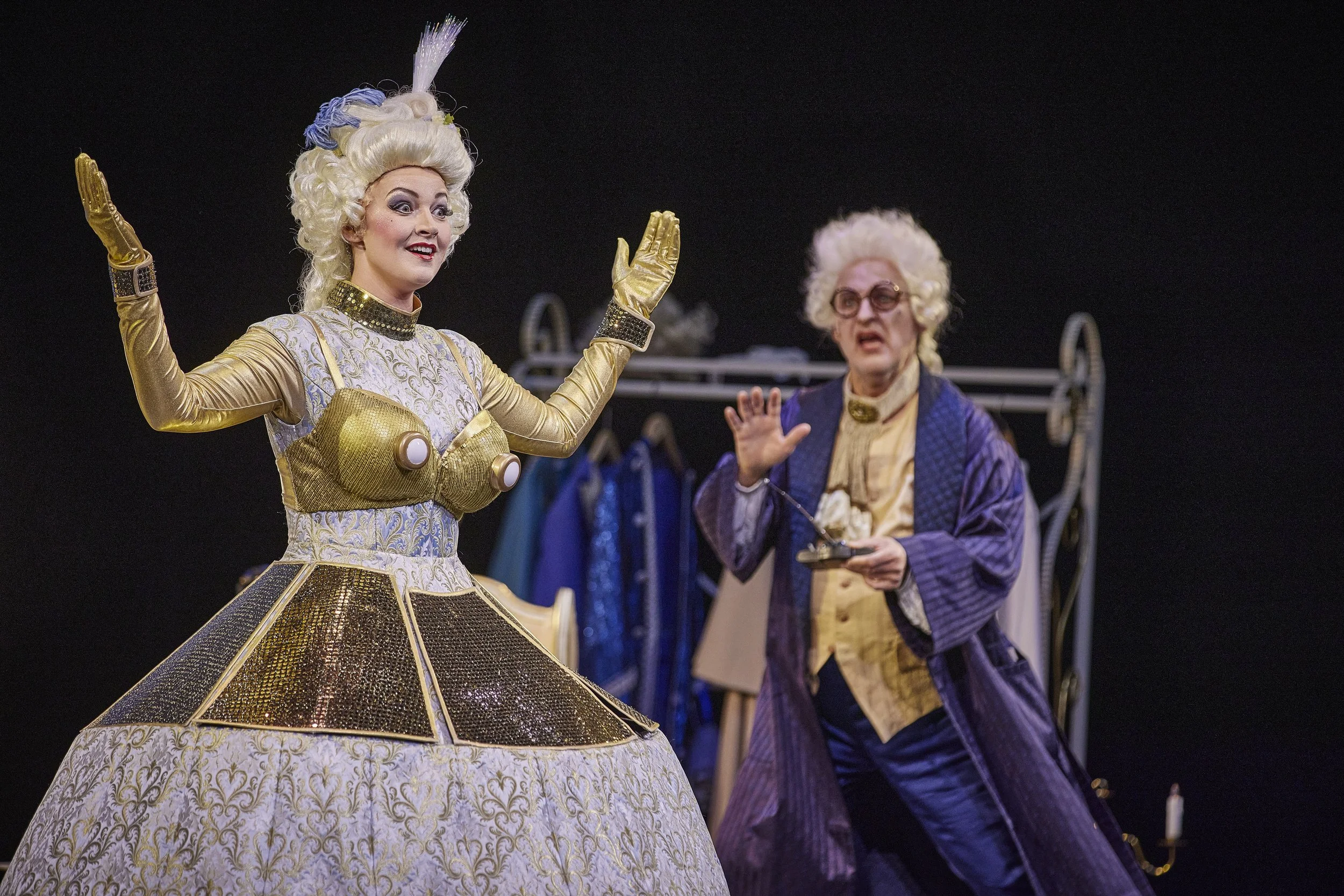
“The director Ilaria Lanzino succeeds in drawing capital from the cheerful intermezzo about the clever, even sly maid and the rich, foolish man—capital that is not far removed from the bloody gold of Bluebeard, except that here the constellation can tip into burlesque in favor of the woman. Vespetta, this clever ‘little wasp,’ literally buzzes and rolls her way into Pimpinone’s life. He, spurred on by TV advertising, wants to ease his womanless existence with a household helper who, according to the premise, can only satisfy male interests as a working machine, that is, as a female and non-contradicting robot. Thus the Baroque machine-being, a male fantasy in gold, a ‘woman’ with glowing nipples, is delivered into the house—and soon emancipates herself from the man who wants to be master and lord but quickly fails at the pitfalls of a self-developing AI. Pimpinone’s ‘detached-from-reality idea of a relationship’ does not reckon with the independence of a being that evolves from doll to autonomous subject. The ‘wild bumblebee’ frees herself, sends him back to where she once came from, and leaves him mute. In doing so, she takes revenge on millennia-old patriarchy. The laughter, even when Pimpinone joins the defiant woman in the bumblebee duet as a laughing pair, is on her side—yet the price is not asked for. It’s just a comedy—with deep meaning.(…) At the end of Bluebeard, that very price is questioned. When Judith, not hastily but clearly enough, leaves the man who has proven incapable of a relationship, she too weeps the tears locked in the sixth chamber. The three women, severely wounded victims of the man, have already freed themselves earlier by simply leaving. The tragedy begins not with Béla Balázs’s prologue, but with a poem by Else Lasker-Schüler: ‘You have written a dark song with my blood…’ Balázs’s text has much to do with that blood which, in the second part of the evening, flows not only in the music. Lanzino stages the ‘myth of the soul’—as the librettist described his work—in which the castle and its chambers are pure structures of sealed interiority. When Judith and the Duke enter the space, they—separately—enter two identical bedrooms: except that in Bluebeard’s room, a warm light illuminates the space, while in Judith’s room, cold light reveals bloody stains on the gray walls. One already knows how it will end when Bluebeard removes all the personal belongings she brings into the marriage. Spatially separated, they are nevertheless connected, above all through violence: when Bluebeard acts on the left, Judith reacts on the right as if he were in the room. Torture chamber and armory mean blows and brutal sexual intercourse. Treasury and garden mean a piece of jewelry and a pregnancy—but the blood clings to the neck as well as to the belly. When the partition between man and woman is finally removed, we hear the magnificent—and shattering—music of Bluebeard’s realm, and for a brief moment the utopia of an opening appears. What follows is a liberation that cannot truly be one: Judith leaves, the price is high, the man remains behind in his darkness—both a victim of his psyche and a perpetrator of violence against the women whose love he betrayed. In this way, the direction finds a just perspective on the Bluebeard problem, one that can be resolved neither as mere accusation nor as cheap excuse.”
Der Opernfreund
“To stage Duke Bluebeard’s Castle without the notorious seven doors is not new. But the young director Ilaria Lanzino comes up with something genuinely convincing: the first and the last door are the same, the flower-adorned portal through which Bluebeard brought his fourth wife into the house. When the wedding portal disappears upward, two identical bedrooms become visible. In the left, friendly and bright one, Bluebeard acts; in the right, Judith sees the same space in gray. Since both interact normally with one another, it becomes clear that they are in the same room but perceive things differently. Bluebeard sees the world through rose-colored glasses when he presents his treasures. His view includes what he considers masculinity, and just as conservative is his view of his wife’s role. Discovering this is exciting for the audience.”
Bernd Feuchtner, infoklassik
“With her light-handed, perfectly music-driven play, Lanzino demonstrates that she has great talent for updating comic material.”
Die Opernwelt
Stage direction: Ilaria Lanzino
Stage and costume design: Emine Güner
Fotos: Ludwig Olah